Sacred Texts from the British Library
These were Flash videos. Since Flash is now obsolete, these are no longer available at the original website. Before they were discontinued, I made screencasts for the videos, using Studio in Canvas. Below are links to these Studio videos.
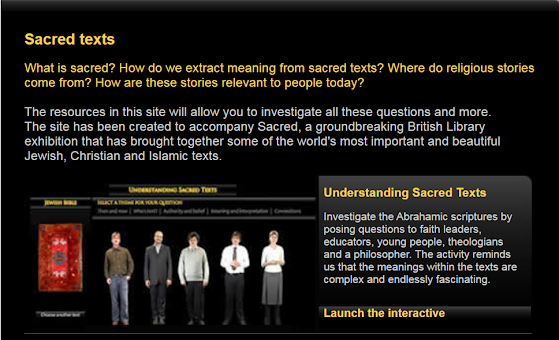
An academic, an educator, a faith leader, a young person and
an atheist share their thoughts on the sacred texts of the three Abrahamic
religions: Judaism, Christianity and Islam.
There are five themes, each with three questions that the different kinds of people from the three Abrahamic religions address, each in their own way. I recorded the videos based on the question, allowing each person who addresses the question to speak (it thus being a sort of "interfaith dialogue"). This way you (the viewer) can compare and contrast what these people have to say in response to each question.
I suggest that, before you view the videos, you consider how you might answer the question. Then, after you listen to how others in the video have responded, you can think about how you feel about what each person had to say.
Theme 1: Then and now
1. How can a text written many years ago help people to deal with their lives today?
2. In what ways do the texts influence lives today?
3. Would you ever use computer technology instead of a book or scroll?
Theme 2: Whose text?
1. What if your conscience disagrees with a ‘rule’ from scripture?
2. Are there parts of the text that are particularly special for you?
3. Imagine that you have been asked for a cut-down version of this text. What would it contain?
Theme 3: Authority and Belief
1. Do believers need help to understand the text? Why or why not? From whom?
2. What is sacred? Why are these texts sacred?
3. Many religious people refer to scripture as the 'Word of God'. What does this mean? Does it matter?
Theme 4: Meaning and Interpretation
1. What are the advantages or disadvantages of translating scripture?
2. Is there truth in the text?
3. Are there any contradictions in the text?
Theme 5: Connections
1. Could a religion exist without scripture?
2. The word 'religion' originates from a word that means 'to bind'. To what does religion bind people? And how might sacred texts help with this "binding"?
3. How does your text relate to the other Abrahamic texts?

Theme 5 connections
ReplyDeleteCould a religion exist without scripture?
I would answer this with my initial understanding and than the information I got after watching the entire video from different perspectives of different religious scholars around the globe. I agree with the islamic and Judaism viewpoin that scriptures play a vital part in writing the history and it enables the stories and the wisdom of that religion to be spread to a much wider audience. It not only keeps the chain of transmitters going from one generation to another keeping it safe in a book that cannot be changed. I also agree with the young person who said scriptures unite people together in believing a certain message which was something of a new thought for me and very interesting because a religious scripture has the power to unite people which i deeply pondered after reading that viewpoint.
If i had to compare most people had similar answers that scriptures are really important in order to preserve vital messages and its purpose it is important for preserving real events and its authenticity however the did not all agree on how the text should be interpreted.